Two significant vulnerabilities affecting the PHP core have been identified: CVE-2026-109618 and CVE-2026-109619. For additional technical details about the vulnerability, please refer to the official advisory
This guide outlines how to configure a custom BigFix Inventory (BFI) signature to discover endpoints running vulnerable versions of PHP across standard paths and extracted source directories.
Vulnerable Version Thresholds
Based on release notices, the following versions are affected:
PHP 5.4.0 up to (excluding) 8.2.35
PHP 8.3.0 up to (excluding) 8.3.36
PHP 8.4.0 up to (excluding) 8.4.27
PHP 8.5.0 up to (excluding) 8.5.12
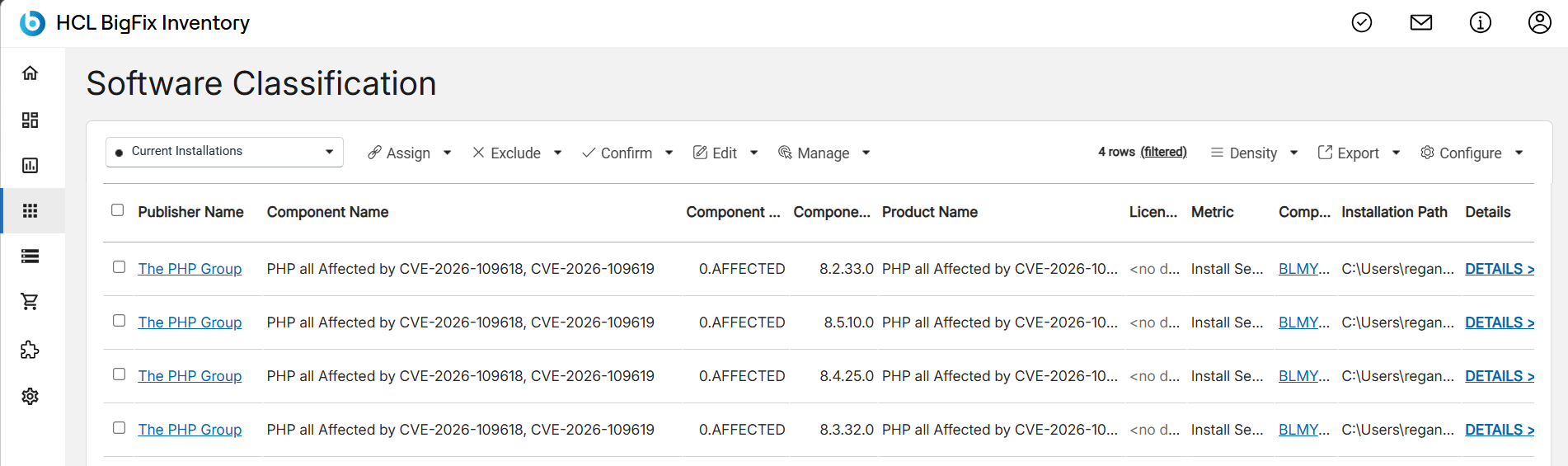
BigFix Inventory can be used to identify systems where the affected PHP installations or extracted source directories are present within the environment using the custom CIT signature below.
Custom CIT signatures have been created for AFFECTED Versions:
Component Name: PHP all affected by CVE- 2026-109618,CVE- 2026-109619
Signature discovery has been verified in BigFix Inventory (BFI) versions 11.0.6 and 11.0.9. Could you please let us know which version of BFI you are currently using?
In BigFix Inventory, go to Administration → Catalog Customization and check whether the component ‘PHP all affected by CVE-2026-109618 and CVE-2026-109619’ or any of its signatures are already present.
If it is, select the top-level node in the software/signature tree (the component entry, so that everything under it is included), click Delete, and confirm.
Run a data import so the deletion is processed.
Import the custom catalog XML again, then run another data import.
I do not already have the PHP signature installed.
I downloaded a few other signatures and tried to import them but got the same error, I guess there’s an issue with my BFI installation. I’ll open a ticket with HCL.
Are those signatures sufficient? From what I gather php/php.exe are the local CLI interface but php-cgj/php-cgi.exe are the interface to receive the web-based requests… You can have both or either on a machine, and you can even technically have different versions of each, and each can carry the vulnerability based on the version they are compiled from. Hence, me asking the question if the above signatures are sufficient to cover the entire vulnerability, i.e. shouldn’t there be equivalent signature to detect for php-cgi executables as well?
Thank you for the feedback! We plan to expand signature detection incrementally, and we will certainly take this into account and work to include CGI components in upcoming updates.
I downloaded a few other signatures and tried to import them but got the same error, I guess there’s an issue with my BFI installation. I’ll open a ticket with HCL.
Oddly enough, a simple reboot of the BFI server fixed this issue.
Added an additional signature for php-cgi.exe alongside php.exe to ensure web/FastCGI handlers are detected for Windows.
No extra signature is needed for Unix/Linux as the existing php-common package signatures covers both php-cli and php-cgi due to their core dependency.